Industry Model Tokens & Computing-Power Integration — Deepening High-Value Scenarios

For vertical industries such as energy and power, government affairs, and manufacturing, we provide exclusive large-model token services fine-tuned on domain data.

Functional Overview

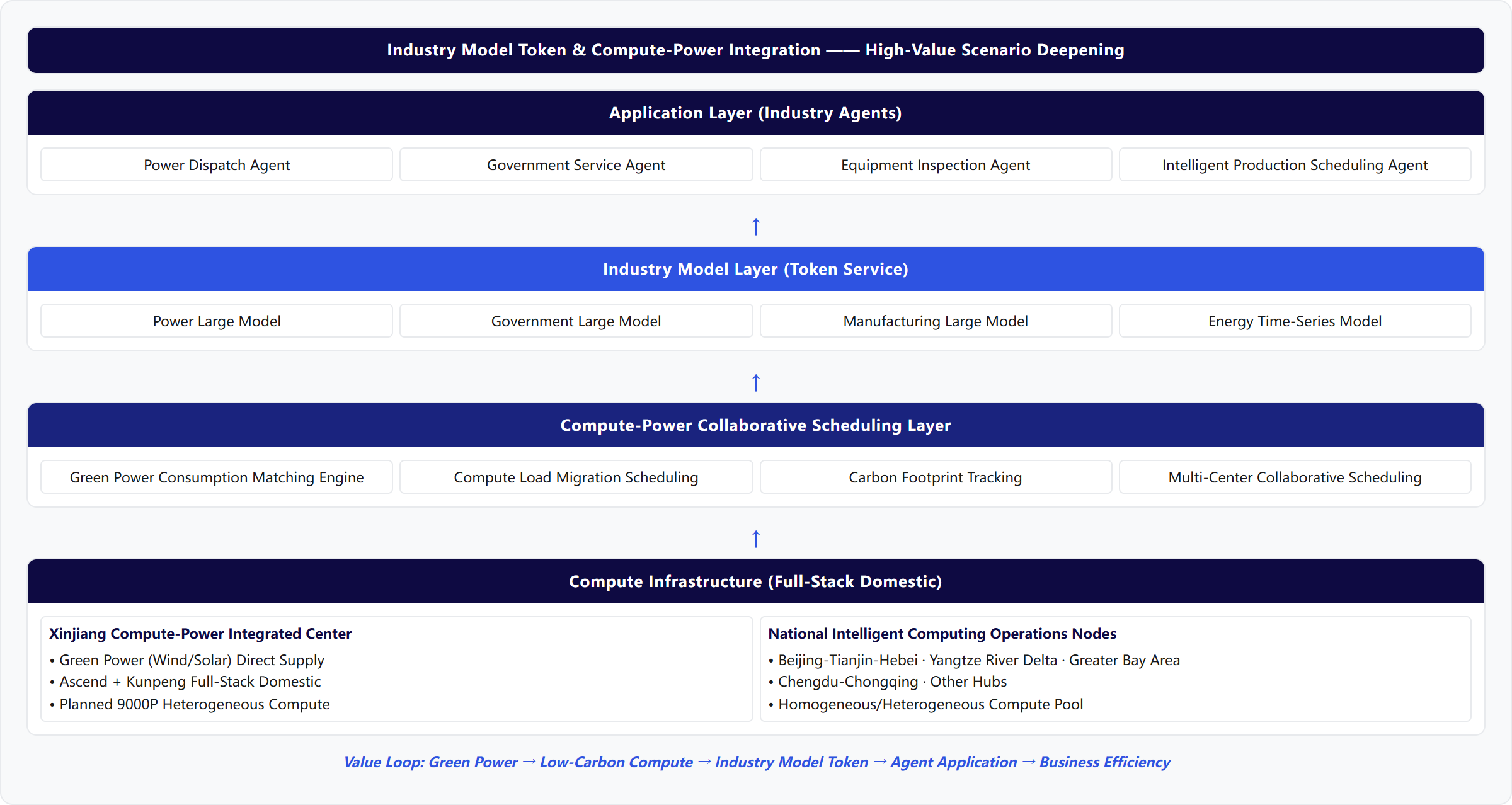
For vertical industries such as energy and power, government affairs, and manufacturing, we provide exclusive large-model token services fine-tuned on domain data, supporting private deployment or public dedicated-zone models to ensure data compliance and business accuracy. We pursue "computing-power + electricity" coordinated scheduling to dynamically match computing load with fluctuations in new energy generation.
Customer Pain Points

  • Generic models don't understand the industry: specialized domains such as power, government affairs, and manufacturing have complex terminology and rules, so generic large models give answers that deviate from business reality and cannot be used directly.
  • Private deployment costs are high: full-model privatization requires dozens of servers, unaffordable for small and medium scenarios; public APIs carry compliance risks around data cross-border transfer.
  • Computing power and electricity are disconnected: the western region has abundant green power but little computing demand, while the eastern region is short of computing power but has high electricity costs, lacking a "computing-electricity coordination" scheduling mechanism.
  • Replacement is incomplete: some solutions only replace compute cards, while operating systems and databases still rely on foreign technologies, failing to achieve full-stack autonomy and control.

Solution Advantages

  • Industry-specific model tokens: combining industry data assets in energy and power, government affairs, and manufacturing, we provide industry large-model token services via private deployment or public dedicated zones to meet data compliance and business customization needs.
  • Computing-power-electricity integrated benchmark project: through means such as acquiring the Xinjiang computing center (with a planned capacity of 9,000P), we aim to achieve integrated design of computing centers and green power consumption, creating a national-level demonstration of "electricity-computing integration."
  • Agent token closed loop: through the OpenAgent platform, computing-power tokens are converted into agent invocation tokens, forming a value-multiplication chain from computing power to model to agent.
  • Full-stack localization adaptation: supports both NVIDIA cards and domestic cards (Ascend) to meet different customer paths for localization replacement.

Architecture Diagram

Architecture Diagram