Modern Medical Complex Smart Campus Solution

Functional Overview

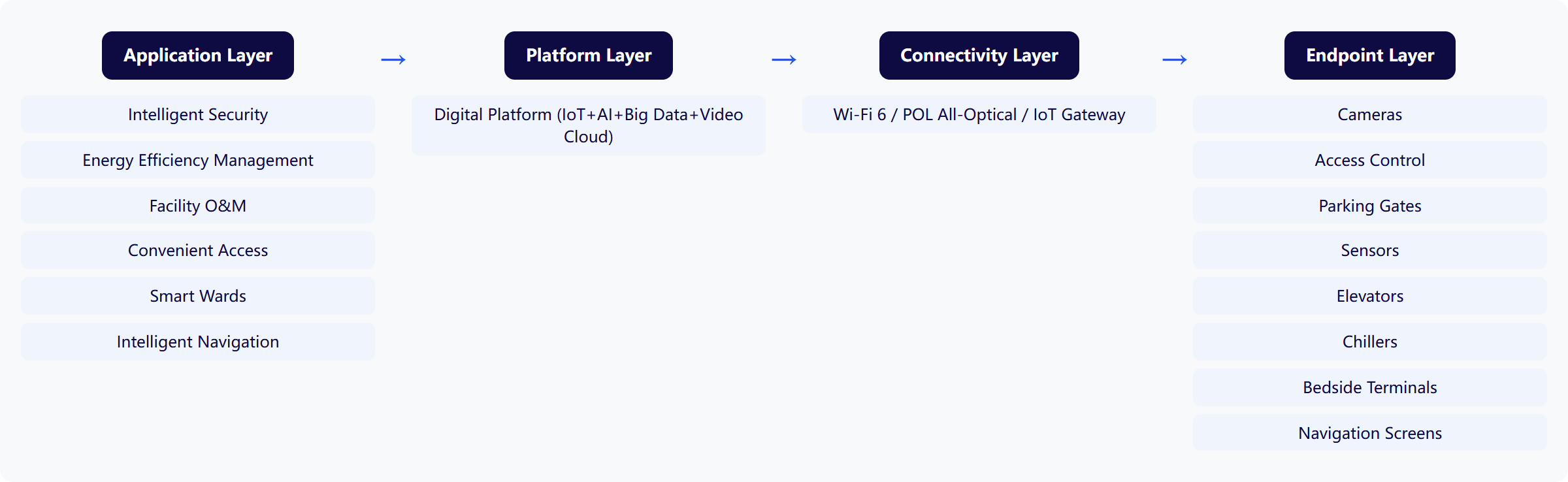
On the device side, it integrates all terminals such as security cameras, access control, parking gates, energy consumption sensors, and ward call buttons; on the connectivity side, it achieves ubiquitous connection through Wi-Fi, POL all-optical networks, and IoT gateways; on the platform side, it builds a unified digital platform integrating AI, big data, and IoT capabilities; on the application side, it provides intelligent security, energy efficiency management, facility O&M, convenient access, smart wards, intelligent guidance, and other applications, and realizes campus-wide visibility, manageability, and controllability through the IOC operations center.
Customer Pain Points

  • High security risks: the campus has dense foot traffic, traditional monitoring relies on manual oversight, and abnormal events are responded to slowly.
  • Rough energy management: air conditioning, lighting, and medical equipment account for a high proportion of energy consumption, lacking dynamic optimization means.
  • Passive facility O&M: failures in elevators, HVAC, power supply and distribution, and other equipment disrupt medical order, and the repair reporting process is cumbersome.
  • Poor medical experience: difficult parking, long queues, and hard-to-find departments lead to low patient satisfaction.
  • Data silos: subsystems operate independently, and management decisions lack data support.

Solution Advantages

  • Intelligent security: AI video analysis (person falls, restricted areas, fire/smoke detection, medical disturbance behavior recognition), linked with access control and broadcast automatic early warning, shortening response time to the second level.
  • Energy efficiency management: dynamically regulates air conditioning, lighting, and fresh air based on foot traffic, outdoor weather, and equipment load, achieving comprehensive energy savings of 15%–20%.
  • Facility O&M: predictive maintenance for equipment (elevators, chillers, water pumps), early fault warning and automatic work order dispatch, reducing MTTR by 40%.
  • Convenient access: license plate recognition + frictionless payment, parking guidance; face recognition access control, online visitor appointment.
  • Smart ward: bedside call, infusion monitoring, automatic environment adjustment, improving nursing efficiency.
  • IOC operations center: 3D digital twin map, real-time display of KPIs such as safety, energy, equipment, and personnel, supporting emergency command.

Architecture Diagram

Architecture Diagram