Public Security Intelligence-Command-Action New Command Platform

Functional Overview

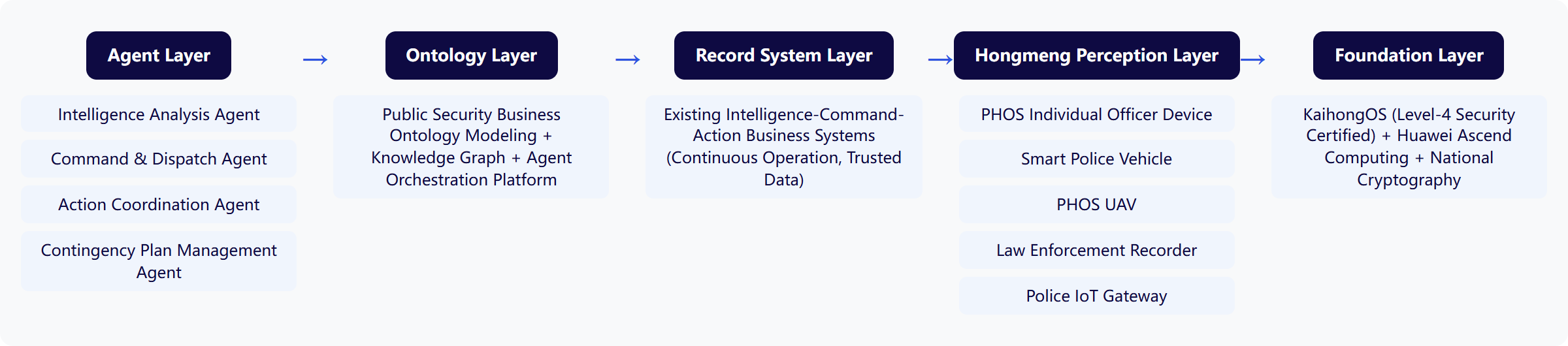
With OpenHarmony and large AI models at its core, it deeply empowers and transforms the existing public security "intelligence, command, and action" platform, building a three-layer architecture of "underlying record system + upper-layer agents," creating a new command platform that can be promoted nationwide.
Customer Pain Points

  • Existing intelligence-command-action platforms consist of dozens of independent systems, with isolated data and difficult cross-police-type collaboration.
  • IoT data generated by OpenHarmony terminals (individual officers, police vehicles, drones) has not been effectively integrated into the command decision chain.
  • Intelligence analysis relies on manual work, early warning is lagging, and pre-event prevention cannot be achieved.
  • Command and dispatch rely on experience, emergency response is slow, and AI-assisted decision-making capabilities are missing.

Solution Advantages

  • Conduct in-depth research on existing machine room systems, clarify system inventories, data flows, police types using them, and pain points, and design platform evolution paths based on facts.
  • OpenHarmony data integration: real-time sensing data from Jinghong terminals (individual officers, police vehicles, drones) is connected to the intelligence-command-action platform, filling original data gaps and realizing a closed loop of "end-edge sensing—platform fusion—intelligent decision-making."
  • Deep AI involvement: in core scenarios such as major event security, emergency command, and key personnel control, large AI models are introduced for automatic intelligence analysis, intelligent plan recommendation, and assisted instruction generation, upgrading from experience-driven to data + AI dual-driven.
  • Three-layer architecture design: retains the original record system as a trusted data source, and builds an ontology-based agent layer on top of it, achieving a smooth evolution of "underlying records + middle ontology + upper agents," without overthrowing and rebuilding, only incremental upgrades.
  • Secure and trustworthy foundation: based on KaihongOS (certified by the Ministry of Public Security at level four) and national cryptographic algorithms, ensuring the security and controllability of police data throughout its lifecycle.

Architecture Diagram

Architecture Diagram