SmartCode Enterprise Intelligent Programming Platform

Functional Overview

SmartCode is an AI intelligent programming platform built by Chinasoft International for enterprise-level development scenarios, positioned as a "generation tool for enterprise agile applications." As a key carrier of the company's AI Coding strategic initiative, it is independently developed and controllable, refined through trial use by tens of thousands of software engineers in real enterprise scenarios, enabling 1% of coding to be done by humans and 99% by AI.

Customer Pain Points

  • AI coding tools remain at single-point efficiency gains—mainstream AI programming tools on the market are mostly designed for individual developers, lacking deep support for enterprise collaborative development, unified code standards, security compliance auditing, and other scenarios.
  • Developer capability assessment lacks objective standards—traditional ratings rely on subjective judgment, unable to accurately identify developer weaknesses and personalized improvement needs.
  • Agile application development responds slowly—during large-scale system migrations such as domestic ERP replacement, enterprises need to quickly generate agile applications adapted to new systems, while traditional development models have long cycles and high costs.
  • AI-generated code quality is uncontrollable—AI-generated code may contain hidden bugs, security vulnerabilities, and performance issues, lacking effective code review, test verification, and quality management systems.
  • Development experience is hard to accumulate and reuse—valuable experience such as scenario understanding, tool usage, and good/bad cases during development is scattered among individuals and cannot be turned into reusable organizational assets.

Solution Advantages

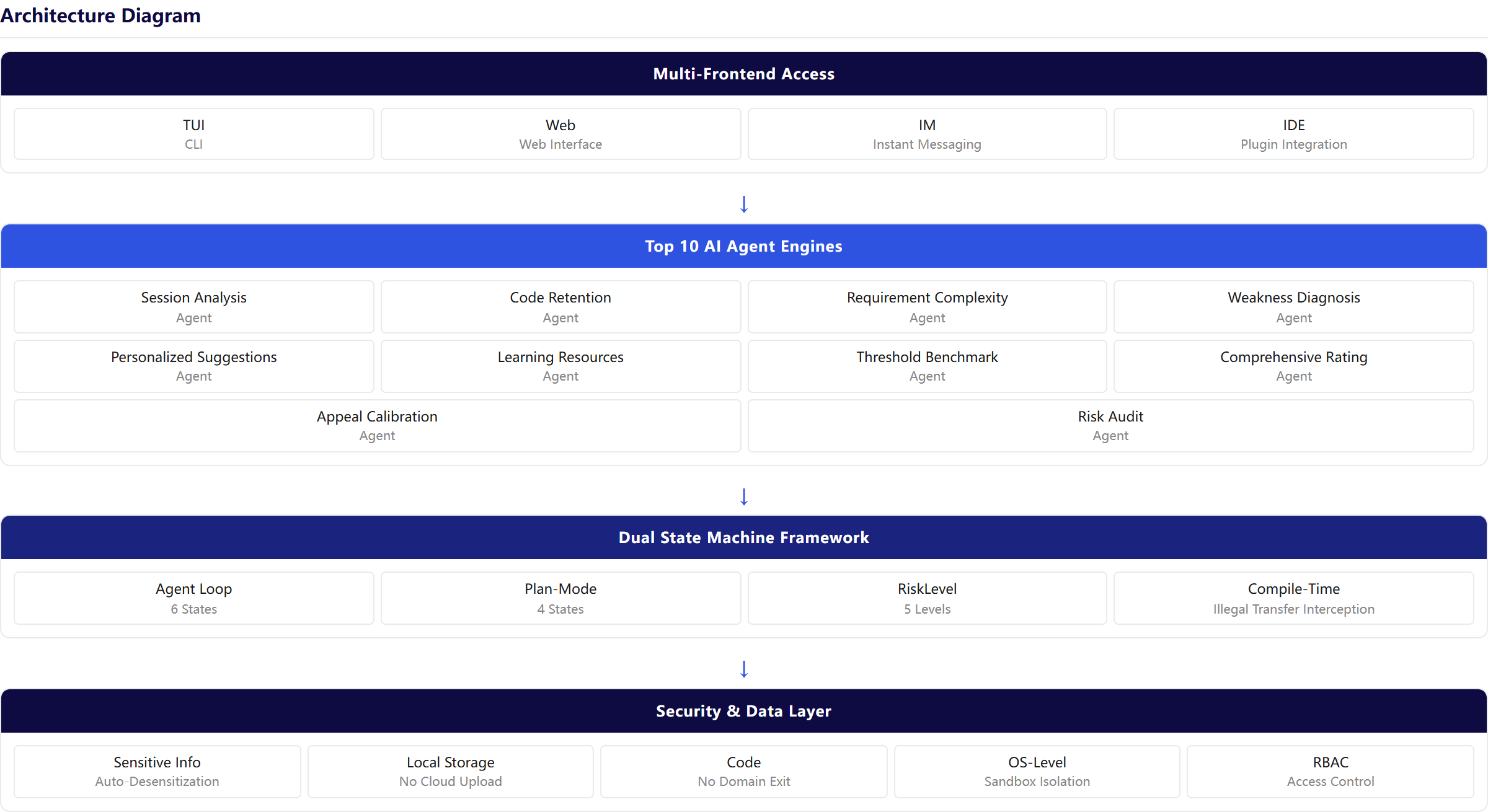
  • Enterprise collaborative development and security compliance: C/S architecture + multi-frontend plug-in design, supporting seamless switching among TUI, Web, IM, and IDE; through local single-process embedding, OS-level sandbox isolation, and automatic desensitization of sensitive information, it ensures enterprise-level code security; built-in enterprise-level authentication and auditing capabilities fully consider the multi-scenario needs of individuals, teams, localization development, and enterprise management.
  • Cross-end session portability: the same session can be switched midway among TUI, Web, and IM, with any endpoint able to resume to the execution point. Append-only event log serves as the single source of truth—all states come from an immutable event sequence. Speaker exclusivity: only one endpoint can speak at a time, switching via claim/release protocol.
  • Dual state-machine scheduling framework: Agent Loop 6 states × Plan-Mode 4 states, orthogonally combined with illegal transitions intercepted at compile time. RiskLevel 5-tier tool grouping: concurrent within the same tier, serial across tiers, and interact exclusivity. Plan-Mode hard whitelist = intersection of state × agent type pure functions, intercepted before dispatch.
  • AI Coding engineering delivery capability: adopts AI specification-driven programming (SSD) + test-driven development (TDD), with code test coverage exceeding 90% and controllable source code quality. Proficient use of AI coding tools enables efficient delivery of production-grade code across the full technology stack, with deep engineering practice capabilities in code review, performance optimization, and security auditing.
  • Ten AI agents empowered: conversation parsing agent automatically analyzes the coding process; code retention rate agent evaluates the retention quality of generated code; requirement complexity agent intelligently assesses task difficulty; weakness diagnosis agent accurately identifies individual capability gaps; personalized recommendation agent pushes exclusive learning resources; learning resource agent intelligently matches the best learning materials; threshold benchmark agent sets capability baselines; comprehensive rating agent periodically assesses capability levels; appeal calibration agent supports result appeals and calibration; risk audit agent audits coding behavior throughout the process.
  • End-to-end delivery and organizational enablement: covers full-link delivery from environment deployment, system integration, data migration to production go-live and continuous O&M, ensuring stable, secure, and continuous operation of AI systems. Through standardized methodology output and an "AI delivery coach" mechanism, it helps customer teams master core skills and form a self-sustaining continuous combat capability.

Architecture Diagram
Architecture Diagram