AI Computing Center Construction & Operations

Relying on the self-built Power Science and Innovation Center flagship project and operational practices in multiple core regions nationwide, we build an AI computing service system of "self-built core nodes + national operations network."

Functional Overview

Relying on the self-built Power Science and Innovation Center flagship project and operational practices in multiple core regions nationwide, we build an AI computing service system of "self-built core nodes + national operations network," providing end-to-end capabilities from computing infrastructure, diverse integration to continuous commercial operations.

Customer Pain Points

  • Computing power is hard to obtain: high-end AI servers (such as B300) are in short supply in the market, with spot prices extremely high (7 million yuan/unit), making it difficult for customers to obtain stable computing power in batches at reasonable costs.
  • High barriers to construction and operation: AI computing centers involve complex technologies such as liquid cooling, lossless networks, and Ascend cluster tuning; most enterprises lack infrastructure and integration capabilities from scratch.
  • Asset idle risk: self-built computing centers require large one-time investment, but computing demand fluctuates significantly; lack of flexible time-sharing reuse and dynamic pricing mechanisms can easily lead to resource waste.
  • Strict security and compliance requirements: government and enterprise customers require data not to leave the domain, physical isolation, and Level 3+ protection, which public clouds cannot meet, requiring dedicated/private computing nodes.
  • Uncontrollable token costs: large-model API calls are billed by token, making it difficult for customers to estimate monthly costs, lacking refined measurement, allocation, and optimization tools.

Solution Advantages

  • Self-built Power Science and Innovation Center benchmark: deeply focused on the energy and power industry, based on the Ascend AI cluster with pre-configured industry large models and high-quality datasets for equipment intelligent inspection, transmission line defect identification, and source-grid-load-storage coordination, providing a trinity service of "computing power + algorithms + data."
  • National computing node interconnection and scheduling: operating in computing hub nodes such as Beijing-Tianjin-Hebei, Yangtze River Delta, Guangdong-Hong Kong-Macao Greater Bay Area, and Chengdu-Chongqing, achieving cross-regional heterogeneous computing resource pooling and intelligent orchestration through a unified scheduling platform.
  • "Investment-Construction-Operation" integrated services: from data center design, equipment procurement, cluster deployment to long-term operations, providing full-lifecycle management; mature time-sharing reuse, dynamic pricing, and multi-tenant isolation mechanisms support diverse computing consumption for government cloud, industry cloud, and research cloud.
  • High-reliability security and compliance operations: physical/logical isolation, data not leaving the domain, Level 3/4 protection compliance, meeting the most stringent security requirements of government and enterprise customers.

Architecture Diagram
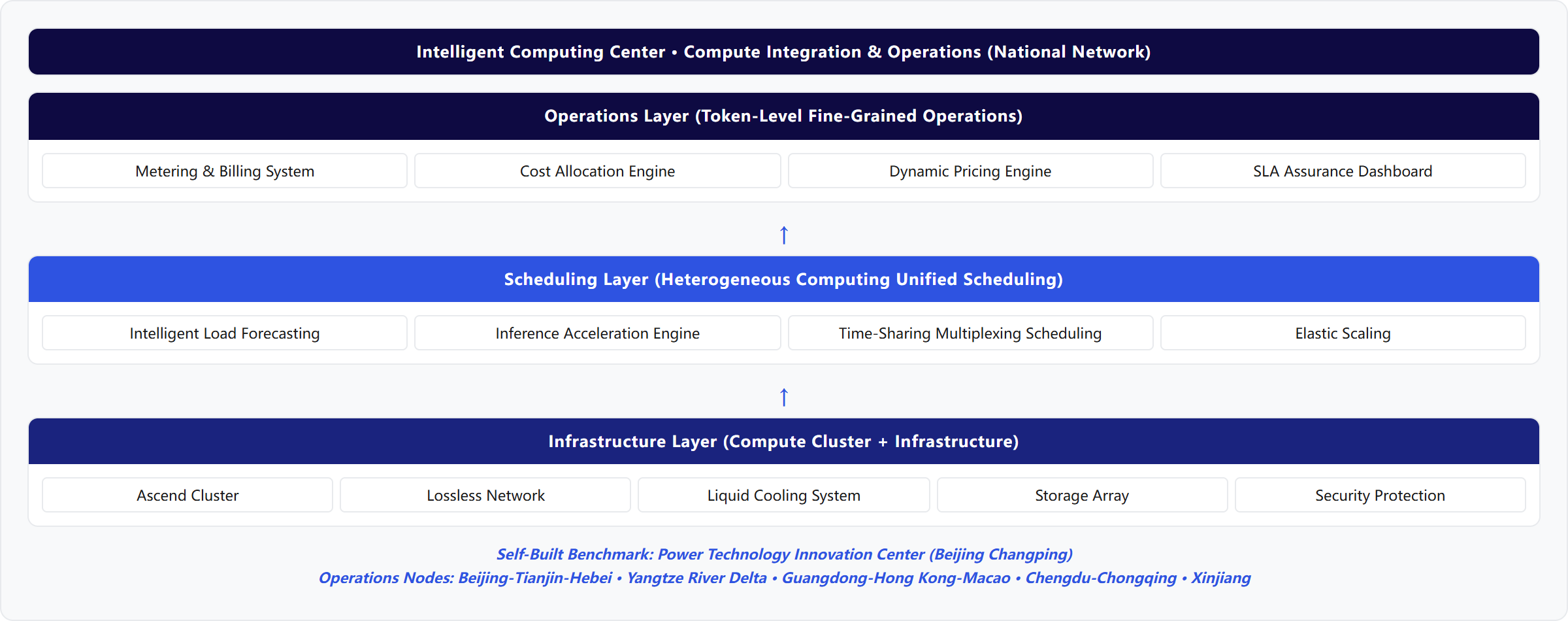
Architecture Diagram