Luhong Smart Transportation Device System

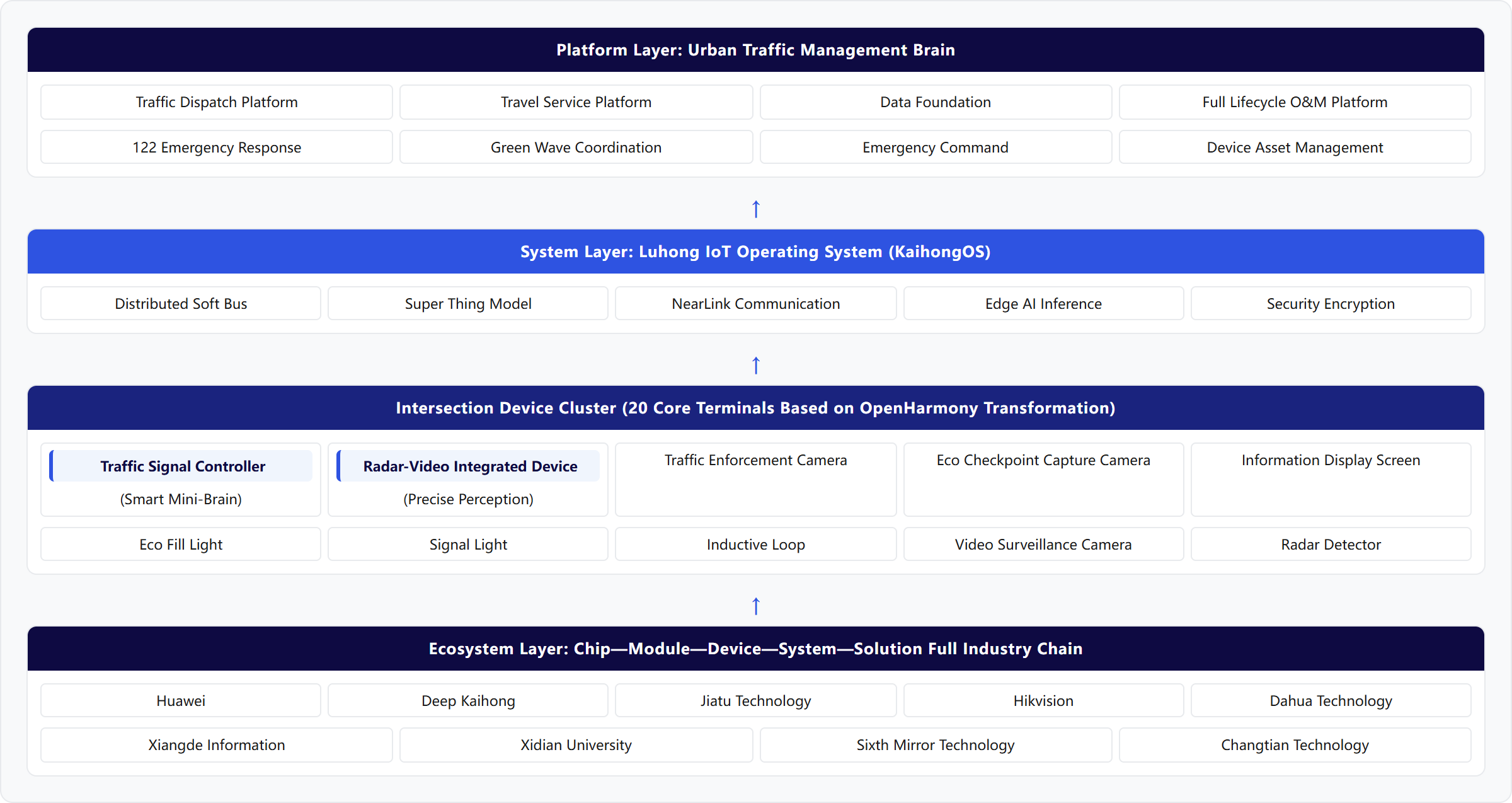
Building the Luhong IoT Operating System based on OpenHarmony and SparkLink, enabling OpenHarmony transformation for 20 common types of road traffic terminals

Functional Overview

Based on OpenHarmony and SparkLink, we build the Luhong IoT Operating System, carrying out OpenHarmony transformation for 20 common types of road traffic terminals, realizing cross-vendor, cross-model device interconnection and 'develop once, deploy across multiple endpoints,' creating an integrated software-hardware, edge-device-cloud collaborative smart transportation solution. Based on the "PHOS IoT Operating System", we build a complete smart policing edge equipment system covering 'Smart Police Officer — Wearable Computing Box,' 'Smart Police Vehicle — In-Vehicle Edge Computing Box,' and 'UAV/Robot Collaborative Combat Cluster,' achieving lighter and more efficient police officer equipment, intelligent police vehicle upgrades, and integrated air-ground collaborative operations.
Customer Pain Points

  • Device fragmentation and inconsistent protocols: More than 3,600 road intersections and over 25,000 terminal devices in downtown Xi'an come from different vendors, with inconsistent protocols and difficult data sharing.
  • Rigid traditional signal control schemes: Traditional intersection signal control mainly relies on fixed timing and cannot dynamically respond to traffic flow changes, limiting congestion management measures.
  • Equipment O&M relies on original manufacturers: Lack of a unified device management platform means fault detection and repair depend on manual point-by-point troubleshooting.
  • High construction costs and impact: Traditional smart transportation transformation requires road excavation and trenching for cabling, resulting in long construction periods, significant traffic impact, and high capital investment.
  • Police equipment has redundant functions and heavy burden: Body cameras, radios, police handhelds, and other terminals are each equipped with separate communication modules, CPUs, batteries, and screens, resulting in high functional redundancy. The total weight of a single officer's main law enforcement devices reaches about 1.5 kg.
  • Police devices operate independently and cannot collaborate: Officer equipment, police vehicles, fixed police equipment (portable dome cameras, verification pillars, etc.), and unmanned equipment (UAVs, robots, etc.) are used independently without interconnection, creating data silos.
  • Low intelligence level of police vehicles: Police vehicles are additionally equipped with cameras, center control screens, and other devices on top of the original vehicle, lacking edge-side real-time analysis capabilities, with most functions relying on the command center.
  • On-site emergency operations lack multi-device collaboration: At incident scenes, officers, vehicles, and UAVs lack unified communication and dispatch mechanisms, making it difficult to form integrated operational capabilities.

Solution Advantages

  • 32 key traffic devices already adapted, covering core intersection categories: Completed OpenHarmony adaptation for 32 key devices including radar-video integrated units, traffic signal controllers, electronic police systems, environmental checkpoints, eco-friendly fill lights, and information displays, with 16 models passing XTS certification.
  • Radar-Video Integrated Unit — Precise Perception and Edge Intelligence: Integrating local military-industry radar technology with video camera technology, it accurately identifies queue lengths at intersections, upgrading traditional 'single-point adaptive' to 'networked adaptive.' The system adjusts traffic light durations in real time based on traffic flow and queue speed, eliminating the 'one-size-fits-all' approach.
  • OpenHarmony + SparkLink Transformation of Signal Controllers — 'Smart Mini-Brain' Empowering Intersection Clusters: By transforming traffic signal controllers with OpenHarmony and SparkLink, and linking intersection radar-video units, electronic police systems, information displays, and other devices, a 'roadside device cluster' based on the distributed soft bus is formed. A trusted governance system ensures full-lifecycle security for more than 4,000 sites and over 9,000 roadside devices.
  • SparkLink communication reduces road excavation: Autonomous and controllable wireless communication significantly reduces the need for road excavation and trenching, lowering construction impact on traffic and aligning with intensive and efficient construction principles.
  • Unified device certification and industrial ecosystem: Established three lists — product requirements, adaptation certification, and innovative products — connecting with more than 20 upstream and downstream manufacturers in the industry chain, promoting the local production of radar-video integrated units, signal controllers, and other devices in Xi'an, and driving output growth.
  • PHOS Smart Police Officer — Wearable Computing Box Turns Devices into Peripherals: Using the 'wearable smart computing box' as the communication, computing, and storage center, other law enforcement devices (body cameras, radios, alcohol testers, etc.) become peripherals, enabling resource sharing and significantly reducing the total weight of a single officer's main law enforcement equipment.
  • PHOS Smart Police Vehicle — In-Vehicle Edge Computing Box Empowering Edge Intelligence: Integrating an all-in-one smart police light solution and deploying an in-vehicle edge computing box, it realizes real-time collection of vehicle status, environmental perception, and biometric data. Edge-side lightweight deployment of core algorithms such as high-precision face recognition and dynamic license plate tracking is completed.
  • Multi-Machine Collaborative Operations — Distributed Soft Bus Enabling Air-Ground Integration: Based on the KaihongOS distributed soft bus, officers' wearable devices, police vehicles, UAVs, and robot dogs are uniformly connected through the super thing model to form temporary combat clusters, achieving multi-view video fusion and collaborative dispatch.
  • Distributed Super Device One-Touch Collaboration: Tablets or large screens can seamlessly control distant robots and UAVs and invoke their onboard cameras and other sensor resources, greatly improving emergency response efficiency.
  • Secure and Controllable End-to-End Encryption: Based on the PHOS secure foundation, full-link police data encryption across cloud, edge, and device is achieved, meeting Ministry of Public Security security standards.

Architecture Diagram

Architecture Diagram