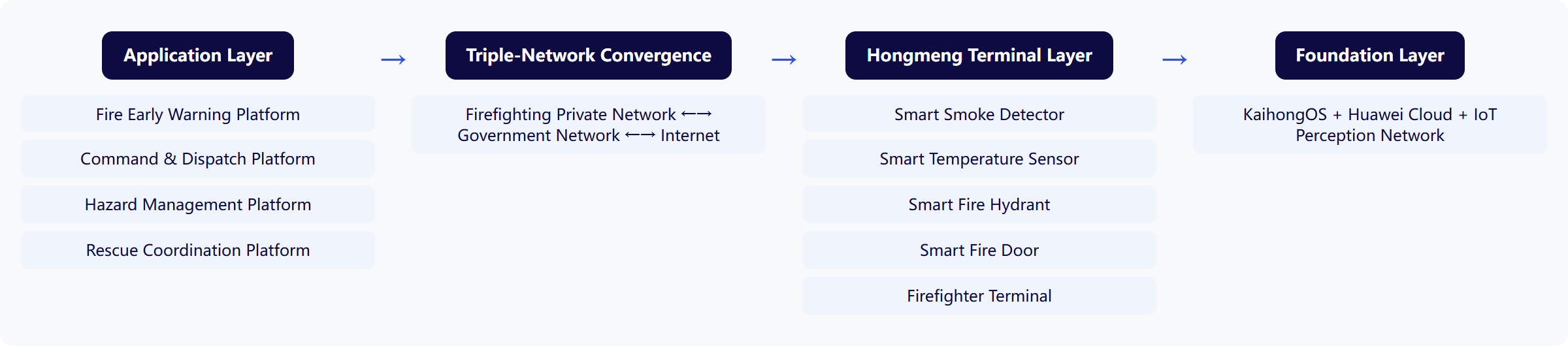
Building a smart firefighting system of 'dual-flow convergence, triple-network integration, and quadruple-prevention combination,' upgrading fire prevention from passive response to active early warning.
Customer Pain Points
Firefighting facilities operate in silos, their status is unknown, and maintenance becomes a mere formality.
Fire detection relies on manual alarms, causing delayed response and missing the golden rescue window.
Information at rescue scenes is not shared; command and dispatch rely on experience.
Difficult to supervise issues such as fire lanes being occupied and abnormal hydrant water pressure.
Solution Advantages
Dual-flow convergence: Integration of business flow (firefighting facility status) and data flow (IoT perception).
Triple-network integration: Interconnection of firefighting private network, government network, and Internet.
Quadruple-prevention combination: early warning (hazard identification), forecast (fire risk trends), rehearsal (evacuation simulation), and plan (linked response).
OpenHarmony-enabled terminals: Smoke detectors, temperature sensors, fire hydrants, fire doors, and other devices are uniformly connected with real-time status visibility.
Rescue scene: Firefighter terminals and command center are linked within seconds, improving rescue efficiency.