OpenHarmony Smart Intersection Solution

Elevating signal control from single-point adaptation to networked self-adaptation

Functional Overview

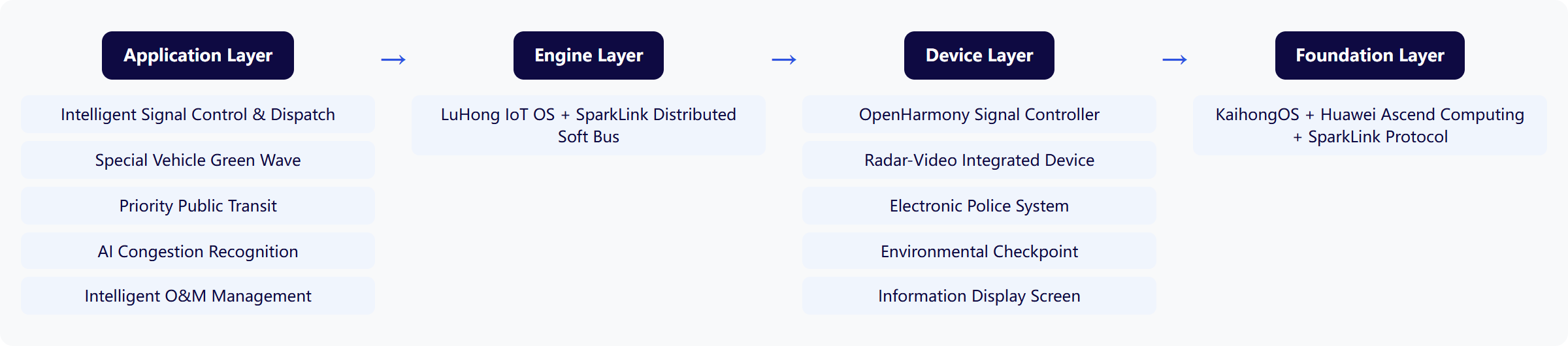
Powered by OpenHarmony, NearLink, and AI, this solution retrofits urban intersection traffic signal controllers with HarmonyOS and NearLink, linking traffic lights, radar-video integrated units, electronic police systems, and other devices to build a distributed soft bus-based 'intersection device cluster.' It elevates signal control from single-point adaptation to networked self-adaptation, comprehensively improving road network throughput.
Customer Pain Points

  • Severe device fragmentation: Terminal devices at central urban intersections come from different vendors with incompatible protocols, making data sharing difficult and creating data silos.
  • Rigid signal control strategies: Traditional signal controllers use fixed timing patterns and cannot dynamically adjust to real-time traffic flow, resulting in low throughput.
  • High O&M costs: Intersection device inspections rely on manual work, faults are detected late, and maintenance response cycles are long.
  • Difficulty for special vehicles: Insufficient guaranteed passage for ambulances, fire trucks, and other emergency vehicles.

Solution Advantages

  • Full-device interconnection: Based on KaihongOS, retrofits 20 types of terminal devices including traffic signal controllers, radar-video integrated units, and electronic police systems, achieving develop once, deploy across multiple devices.
  • Intelligent signal control upgrade: Radar-video integrated units accurately capture traffic dynamics; the system intelligently adjusts red/green light durations based on traffic conditions and queue length. Verified by real-world road tests, pilot intersections saw throughput improve by 20%–25%.
  • NearLink hybrid networking for resilience: Fiber + NearLink hybrid networking covers the entire intersection, enabling multi-path disaster recovery, significantly reducing the need for road excavation during upgrades, and minimizing impact on public travel.
  • Green-wave escort for special vehicles: Based on OpenHarmony distributed technology, video surveillance devices and signal controllers are uniformly interconnected; it takes only 7 seconds from special-vehicle recognition to signal switching, greatly improving emergency passage efficiency.
  • Intelligent, convenient, and efficient O&M: Leveraging HarmonyOS proximity discovery, new devices can be quickly deployed; AI real-time signal status detection reduces inspection workload by 90%, shortening fault response cycles from days to hours.

Architecture Diagram

Architecture Diagram