Code Wiki

Functional Overview

Code Wiki is a code understanding and knowledge accumulation tool in ChinaSoft International's SmartCode ecosystem, positioned to turn legacy systems from "afraid to change" into "understandable and changeable." Based on triple technology of AST (Abstract Syntax Tree) + knowledge graph + large model, Code Wiki can automatically analyze code repositories and generate a "code encyclopedia" containing design philosophy, architecture explanation, and learning paths, supporting natural language Q&A.

Customer Pain Points

  • Legacy code is hard to understand, risky to change, and difficult to modify — enterprises have accumulated massive legacy code repositories. When new teams take over decades of accumulated code without effective understanding tools, every modification feels like walking on thin ice.
  • Code documentation is seriously lagging or missing — traditional code documentation relies on manual writing, and after code iterations documentation is often not updated, making documentation-code disconnect the norm.
  • New members have a long onboarding cycle — new developers need months to understand the architecture and business logic of large codebases, seriously affecting delivery efficiency.
  • Architecture knowledge is tacitly lost — core architects' design ideas and decision logic are lost with personnel changes, turning codebases into "islands that no one dares to touch."
  • Code audit and migration are difficult — in large-scale system migration projects such as domestic ERP replacement, the lack of rapid understanding and assessment tools for legacy code makes migration cycle and risk difficult to control.

Solution Advantages

  • AST + Knowledge Graph + Large Model Triple Technology Driven: based on AST (Abstract Syntax Tree) for precise code structure parsing, through knowledge graph to build dependency networks among code entities, and combined with large model to generate highly readable natural language documentation. The triple technologies collaborate to realize intelligent translation from "code symbols" to "business semantics."
  • Automatically Generate a "Code Encyclopedia" : without manual documentation writing, AI automatically transforms the entire codebase into interactive documentation containing design philosophy, architecture explanation, module responsibilities, core processes, and learning paths. Once the code changes, the documentation automatically updates, completely eliminating documentation lag.
  • Natural Language Q&A — Understand Code Like Chatting: supports developers asking questions in natural language (e.g., "What is the core function of this module?" "Where is this function called from?"), and AI instantly retrieves and answers from the codebase, minimizing the barrier to understanding code.
  • Multi-Language Coverage: supports Python, TypeScript, Go, Java, JavaScript, C, C++, and other 7 mainstream programming languages, covering the vast majority of enterprise-level development scenarios.
  • Market Entry Weapon: Code Wiki can first perform free analysis and demonstration on legacy code repositories of government customers (such as Xi'an Big Data Bureau), as an entry point to expand government and central SOE markets, and promote to dozens of big data bureaus nationwide. It can also be integrated as a CI plugin into the development process, automatically updating documentation with each code commit.

Architecture Diagram
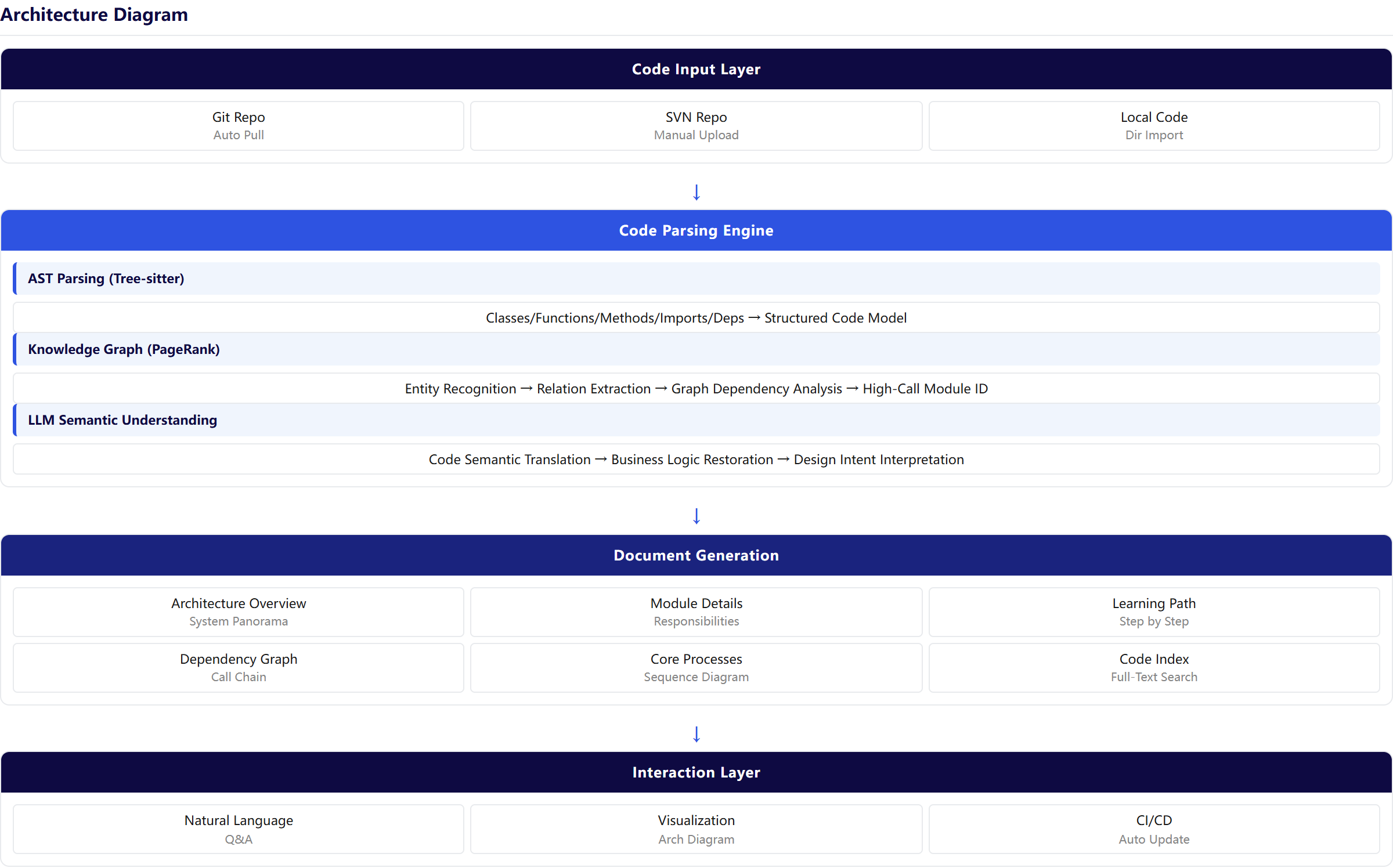
Architecture Diagram