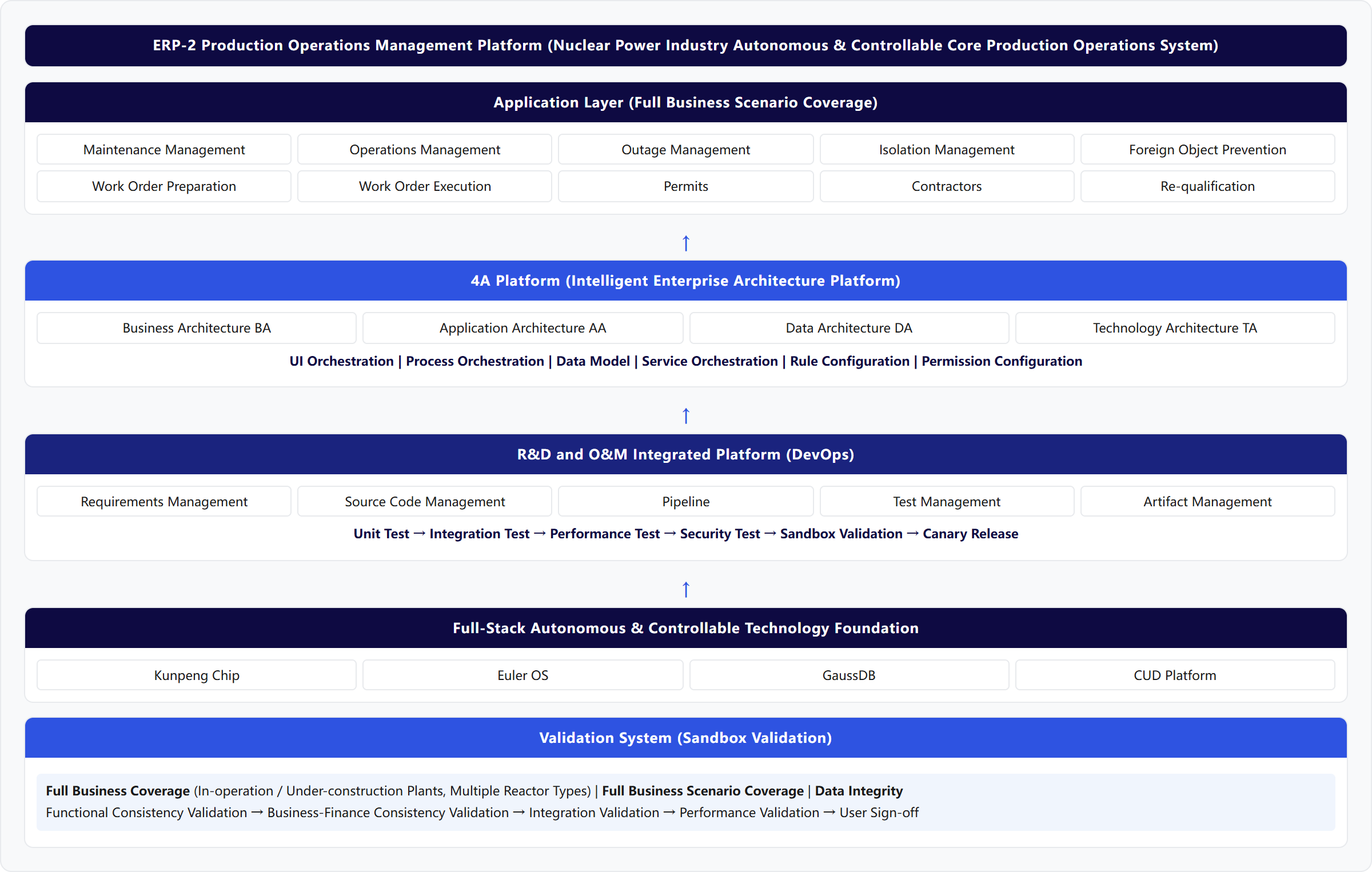
ERP-2 Consulting & Implementation Plan (Production Operations System Replacement/Upgrade)
Replace/upgrade an autonomous and controllable production operations management system, covering core production operations domains.
Functional Overview
Replace/upgrade the autonomous and controllable production operations management system (ERP-2), covering core production operations domains such as equipment management, work management, operations management, and permit management.
Customer Pain Points
Deep reliance on existing ERP systems: Nuclear power production and operations heavily depend on existing ERP modules such as PM/PS; replacement involves large-scale business process restructuring.
Strong nuclear power business specificity: Scenarios such as work-order preparation, isolation management, foreign object prevention, and outage management require deep customization; generic ERP cannot directly replace them.
Aging existing system technology: Existing ERP system performance is declining, upgrade costs are high, and expansion is difficult.
Self-developed capabilities need building: A complete self-developed system must be established from "requirements analysis → product design → development & testing → sandbox validation".
Solution Advantages
Fully autonomous and controllable: Self-developed products are built on a homologous and isomorphic intelligent development platform, independent of any foreign commercial software, meeting the highest-level Xinchuang (IT application innovation) requirements.
Deep adaptation for the nuclear power industry: Covers nuclear-power-specific business scenarios (isolation, foreign object prevention, outage, requalification, etc.), supports differentiated needs of operating, under-construction plants and multiple reactor types, and fits business operations better than standard functions of existing ERP systems.
4A architecture penetration: Adopts a business architecture (BA), application architecture (AA), data architecture (DA), and technical architecture (TA) penetration approach, deconstructing layer by layer from L1 domains to L5 activities to ensure 100% coverage of existing key functions by self-developed products.
End-to-end self-developed product R&D system: Based on IPD methodology, establish an integrated full-process R&D management platform (4A Platform) spanning requirements analysis, product design, development & testing, sandbox validation, and pilot promotion.
Sandbox validation-driven quality assurance mechanism: Based on desensitized production data, carry out full-process, full-scenario hands-on validation in a sandbox environment (full business coverage, full scenario coverage) to ensure functional consistency, data integrity, and business-finance consistency.
Scalable architecture and continuous iteration capability: Based on microservices, multi-tenant metadata, low-code orchestration, and other technologies, it supports flexible extension of business objects, processes, rules, and UI, enabling rapid response to member-unit-specific needs and future business evolution.