Luhong IoT Operating System

Based on KaihongOS and NearLink technology, building the 'Luhong' IoT operating system

Functional Overview

Based on KaihongOS and NearLink technology, we build the 'Luhong' IoT operating system, transforming and upgrading common road traffic terminal devices, achieving 'develop once, multi-terminal linkage', and reconstructing the urban traffic management system with a unified digital base.
Customer Pain Points

  • Severe device fragmentation: More than 3,600 intersections and over 25,000 terminal devices in Xi'an come from different manufacturers, with inconsistent protocols and difficult data sharing.
  • Low manual patrol efficiency: Traditional road monitoring relies on manual street patrols, with traffic light failures not discovered in time and response cycles measured in 'days'.
  • Lagged emergency response: Emergency handling at key nodes such as tunnels and intersections relies on manual operations, with long response times that cannot meet second-level requirements.
  • High upgrade and transformation costs: Traditional solutions require road excavation, with large construction impacts and high construction and O&M costs.

Solution Advantages

  • Luhong IoT Operating System: Completed HarmonyOS adaptation for 32 key devices across 9 categories, 25 obtained adaptation center capability evaluation reports, and 16 passed the OpenHarmony ecosystem product compatibility (XTS) certification.
  • NearLink wireless transformation: Uses autonomous and controllable wireless communication capabilities to significantly reduce the need for road excavation, aligning with the 'intensive and efficient' construction concept. A trusted governance system ensures the full lifecycle security of more than 4,000 points and over 9,000 roadside devices.
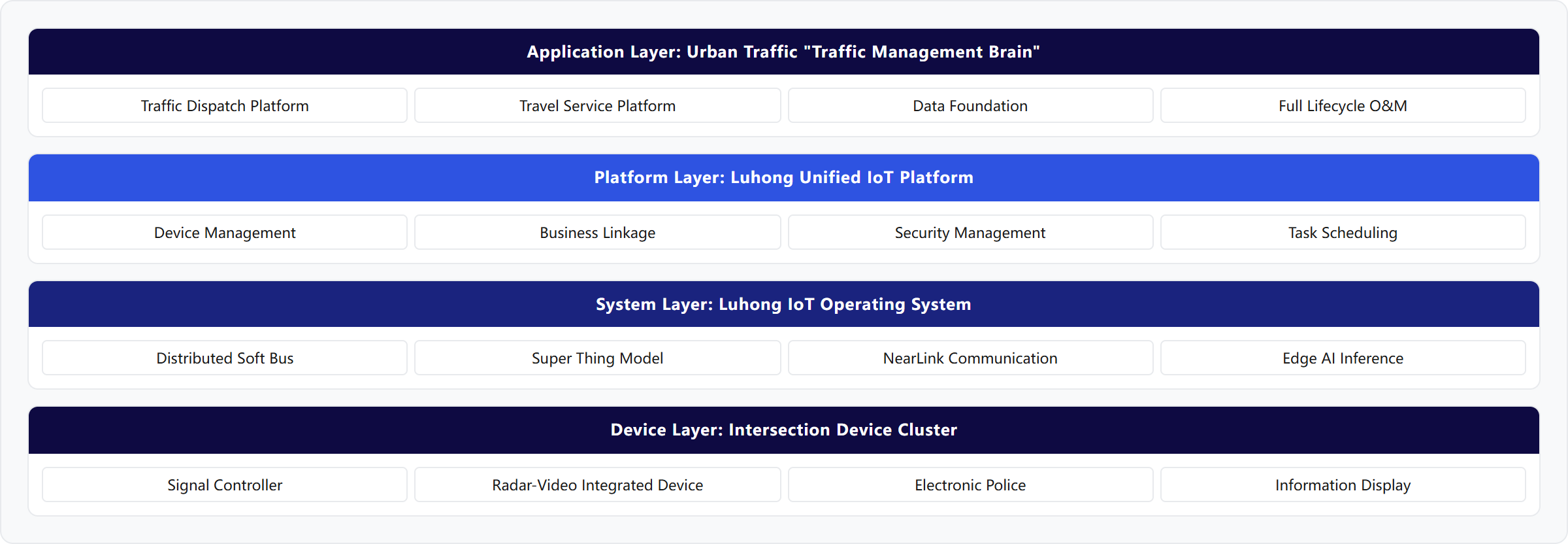
  • Distributed soft bus architecture: Based on the soft bus architecture, we build 'intersection device groups', linking intersection terminal devices to form an integrated perception and control system, supporting the 'traffic management brain' in wide perception, secure access, intelligent decision-making, and trusted control.
  • Radar-vision integrated machine innovation: Integrates radar technology and video AI to accurately identify the length of vehicle queues at intersections. Verified by actual road tests, pilot intersections improved traffic efficiency by 20%-25%.

Architecture Diagram

Architecture Diagram