M-Robots OS

Providing a Unified "Multi-Robot Collaborative Robot Operating System" for the Robot Industry

Functional Overview

M-Robots OS provides a unified "multi-robot collaborative robot operating system" for the robot industry, breaking down hardware barriers and enabling interconnection and collaboration among robots of different forms and brands. Through unified device abstraction, communication mechanisms, and task scheduling, the system provides a consistent operating system environment for heterogeneous robot groups, empowering robots to evolve from "single-machine intelligence" to "swarm intelligence."
Customer Pain Points

  • The robot industry is fragmented with inconsistent standards: robot manufacturers each develop closed systems, robots of different brands are incompatible, and collaboration is difficult.
  • Severe reinvention of the wheel in the industry: each robot needs to develop underlying systems and communication protocols from scratch, with low R&D efficiency and huge resource investment.
  • Lack of unified scheduling for multi-robot collaboration: completing tasks with multiple robots requires complex heterogeneous system adaptation development, lacking unified scheduling and collaboration mechanisms.
  • Robot AI capabilities are difficult to integrate uniformly: robot AI functions are scattered in their own systems, lacking unified AI model and capability sharing mechanisms.

Solution Advantages

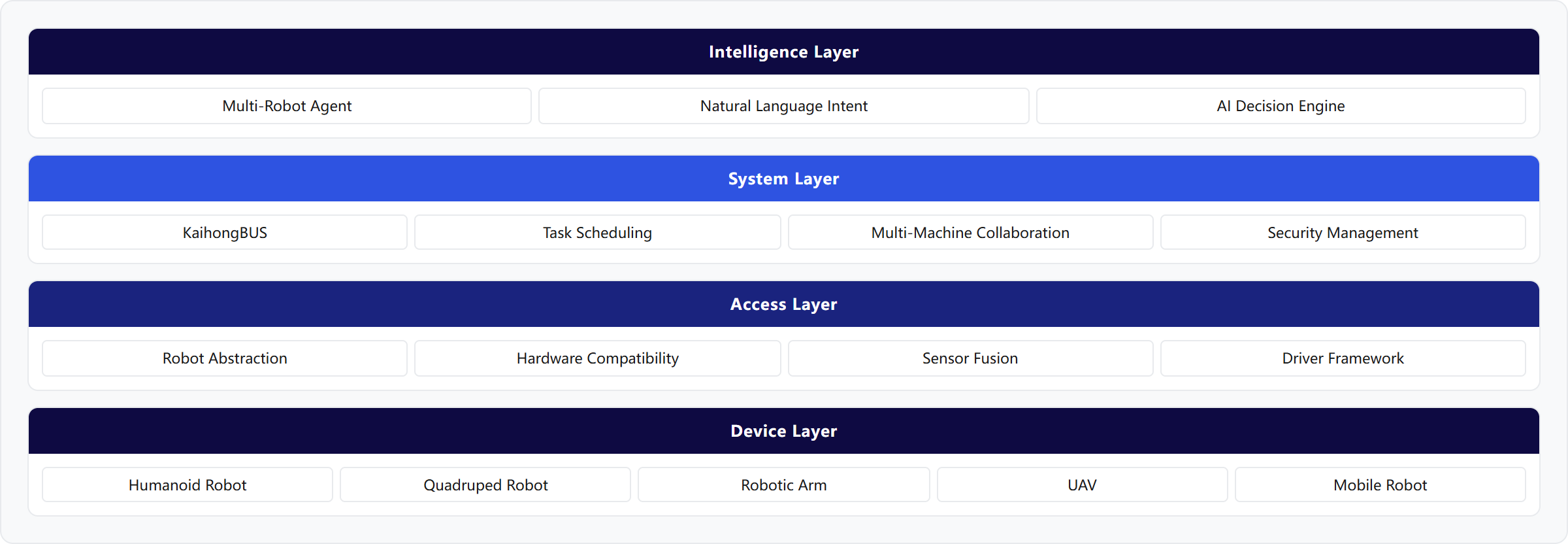
  • Distributed heterogeneous multi-robot collaboration capability: through KaihongBUS technology, it supports multi-robot interconnection, capability sharing, and task collaboration, enabling robots of different forms and brands to move from operating alone to collaborative swarm operations.
  • Multi-hardware compatibility and unified access for heterogeneous robots: compatible with various robots of different forms and brands (humanoid robots, quadruped dogs, drones, robotic arms, etc.), achieving unified access and management. Already compatible with Leju "KuaFu" humanoid robot, "Yu" series quadruped robot dogs, NearLink drones, ROKAE six-axis robotic arms, Tuoxingyun six-axis robotic arms, Digital China humanoid robots, etc.
  • Real-time collaboration and low-latency communication: using KaihongBUS distributed communication mechanism to ensure high real-time performance of multi-robot collaborative operations, adapting to industrial-grade complex scenarios.
  • Deep AI integration: deeply integrates large AI models and multimodal perception capabilities, supporting robots through natural language intent understanding, autonomous decision-making, and swarm collaboration, as well as collaborative control between agents and robots.
  • Embodied intelligence industry support: provides a safe, reliable, autonomous, and controllable underlying communication and collaboration platform for the embodied intelligence industry, supporting AI data collection and model training scenarios such as humanoid robot training fields.

Architecture Diagram

Architecture Diagram