allmeta Ontology

Actionable "Living" Ontology—Turning Business Knowledge into an AI-Executable Brain

Functional Overview

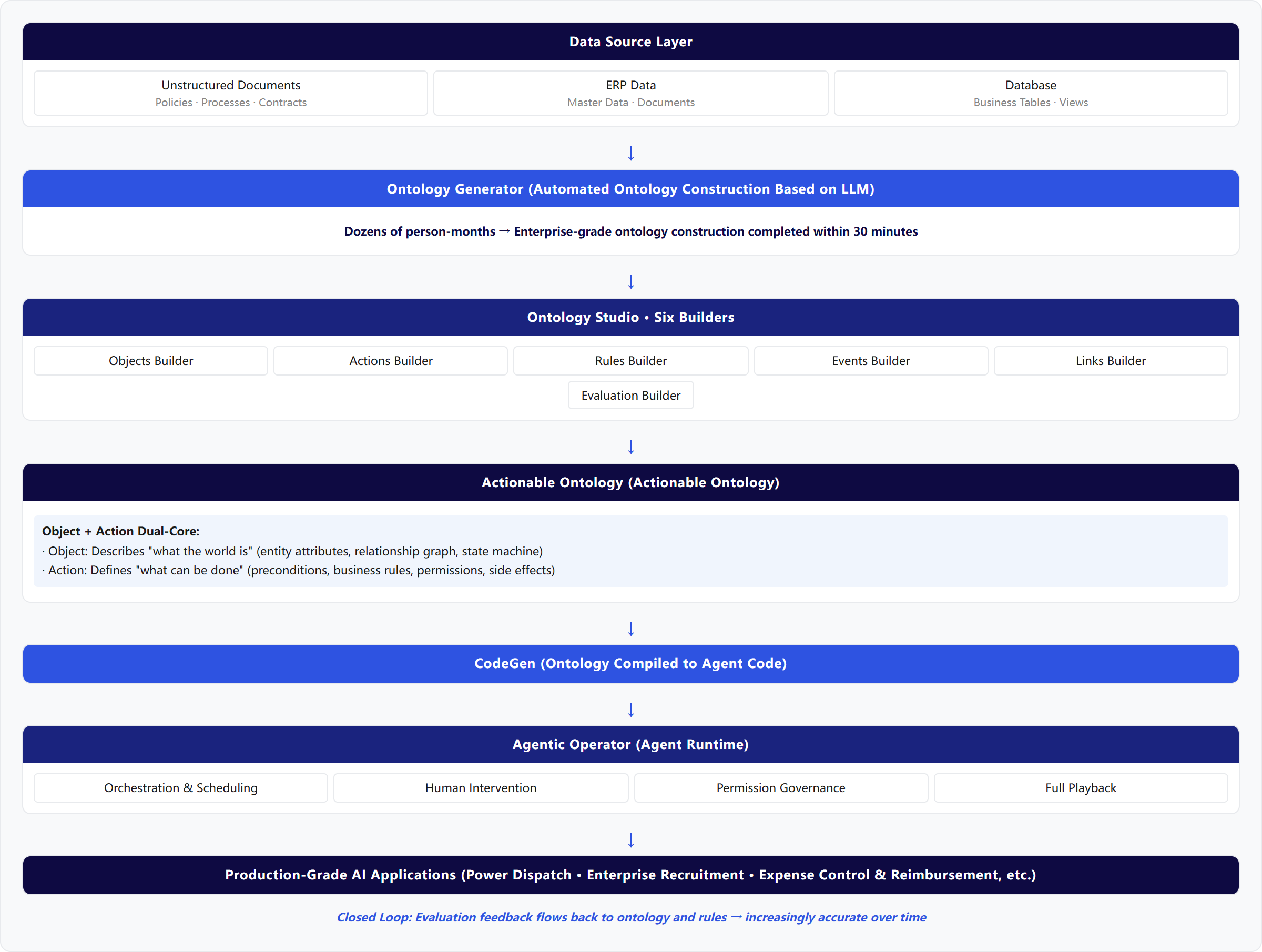
An "actionable ontology" system for the AI-native era. Addressing the pain point that large models cannot understand deep enterprise business rules, allmeta Ontology uses six builders—Objects, Actions, Rules, Events, Links, and Evaluation—to automatically generate operational Agent runtime code and a business-knowledge brain from ERP, MES, and other system data plus unstructured documents, enabling controllable AI execution and full-process code generation without manually orchestrating workflows or writing prompts.
Customer Pain Points

  • Large models don't understand business objects (the relationships between customers, orders, inventory, equipment, and processes), making them hard to deploy in real business scenarios.
  • There are no permission boundaries; it's unclear what data can be viewed, what actions can be taken, and what processes require approval—so it's not safe to put into production.
  • Processes are not auditable or traceable, making black-box automation difficult to use for production decisions.
  • Going from unstructured documents to agent code traditionally requires dozens of person-months, with extremely high engineering costs.

Solution Advantages

  • Automatic ontology construction: based on the LLM-powered Ontology Generator engine, enterprise systems, processes, contracts, manuals, ERP data, and databases are automatically built into an enterprise ontology, completing work that used to take dozens of person-months in under 30 minutes.
  • Visual modeling with six builders: Objects Builder (defines business objects), Actions Builder (defines executable actions), Rules Builder (defines business rules), Events Builder (defines event triggers), Links Builder (defines object relationships), and Evaluation Builder (defines evaluation metrics), allowing business users to adjust agilely.
  • CodeGen automatically generates agent code: compiles actionable ontology into executable agent code that runs in the Agentic Operator.
  • Controlled execution and auditing: every step is traceable, replayable, and auditable, with key nodes supporting manual intervention and approval.
  • Multi-model adaptation: partners with industry models such as Kimi and MiniMax, compatible with open-source models such as DeepSeek, and adaptable to mainstream large models at home and abroad.

Architecture Diagram

Architecture Diagram