allmeta ECore

Building the Intelligence Foundation — Making Enterprise Data Inherently AI-Understandable and Callable

Functional Overview

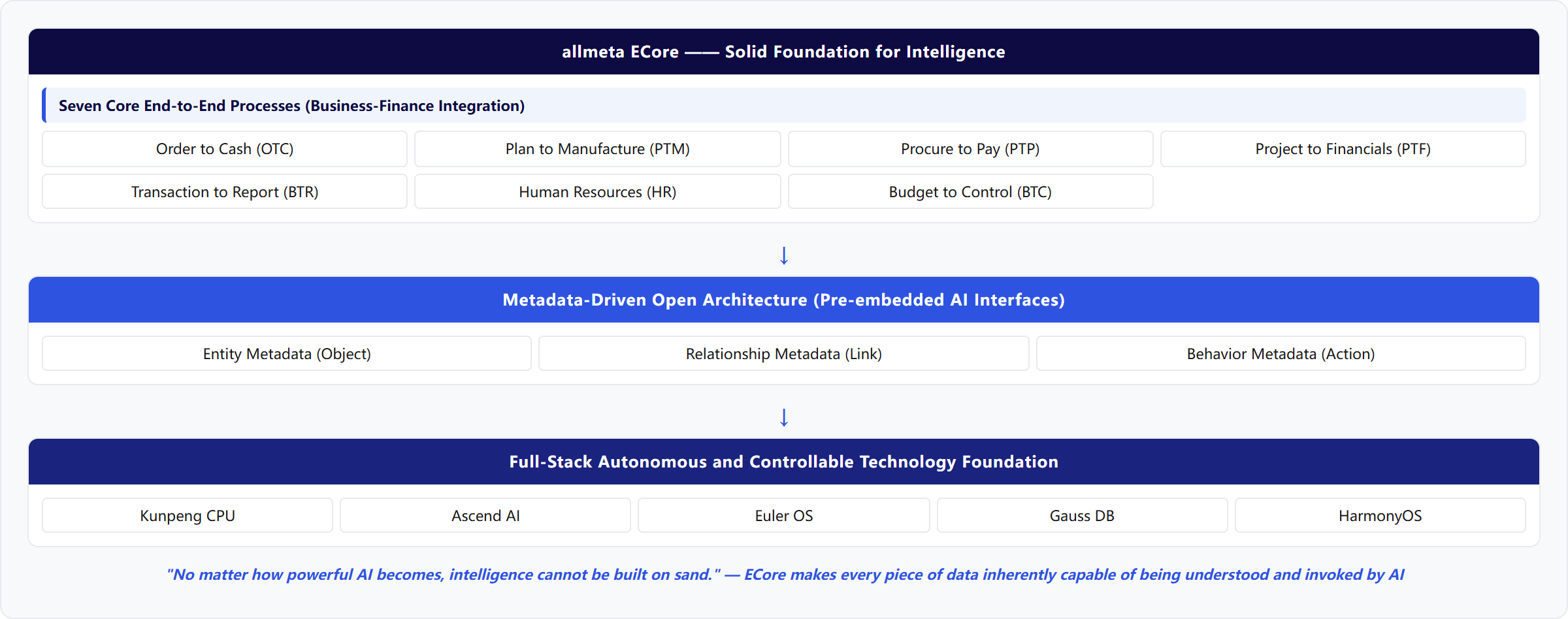
allmeta ECore is the underlying business data foundation of the enterprise intelligent operating system. It fully inherits the core management capabilities of traditional ERP for people, finance, materials, and items, while undergoing an architectural leap for the AI era—replacing closed hard-coding with a metadata-driven open architecture, embedding standardized interfaces in every piece of data for core enterprise entities, making it inherently capable of being understood, called, and operated by AI.
Customer Pain Points

  • Traditional ERP data architecture is closed and heavily hard-coded, making it difficult to support flexible expansion and intelligent invocation in the AI era.
  • The system is positioned only as a "record system," with data passively stored and unable to be actively operated as AI assets.
  • Integration is mainly point-to-point APIs, with an explosive growth in interface numbers, high maintenance costs, and poor semantics.
  • Lack of a unified, secure, and trustworthy data foundation; upper-layer AI applications face the problem of insufficient "data fuel."

Solution Advantages

  • Business-finance integrated management: fully covers core functions such as finance, supply chain, production and manufacturing, human resources, and customer relations, with seven end-to-end processes seamlessly connected.
  • Metadata open architecture: embedded standardized interfaces make every piece of data (customers, orders, materials, equipment, projects, etc.) inherently capable of being understood and called by AI, reducing AI integration costs by over 70%.
  • Full-stack autonomous and controllable foundation: based on Huawei Kunpeng, Ascend, Euler OS, and GaussDB, full-stack localization from chip to application meets localization compliance and data security requirements.
  • Born for AI: ECore no longer outputs isolated form records, but "standard business components" that can be directly referenced by the Ontology layer, serving as the "skeleton and blood" of upper-layer agents.

Architecture Diagram

Architecture Diagram