Intelligent Audit Platform

With a "living" system at its core, it provides full-process, integrated digital audit support capabilities.

Functional Overview

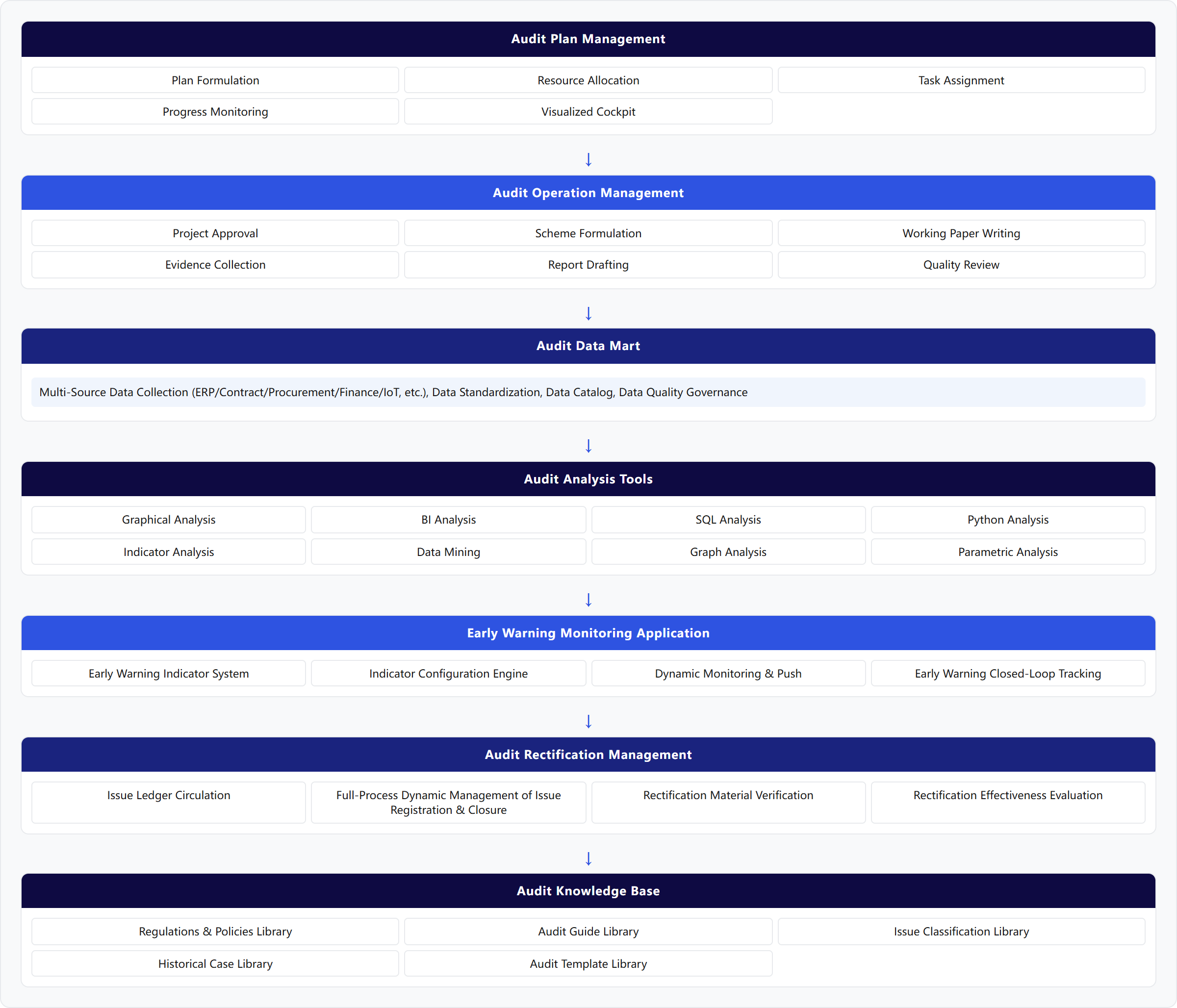
With a "living" system at its core, it provides enterprises with full-process, integrated digital audit support capabilities. The platform covers full-process management from audit plan formulation, project management, audit execution to audit rectification tracking, and has been selected for the "2025 Excellent Innovative Software Products Promotion Catalogue."
Customer Pain Points

  • Audit involves many business systems, with finance, procurement, contract, engineering, and other data fragmented, making it difficult to achieve cross-system, cross-level full-chain penetrating analysis.
  • Traditional auditing relies on manual ledgers and on-site sampling, with low coverage, low efficiency, and poor timeliness, unable to meet SASAC's "full coverage" supervision requirements.
  • Audit models and rules rely on a few experts for maintenance, with updates lagging behind regulatory policy and business changes, leading to insufficient risk identification capabilities.

Solution Advantages

  • "Living" system design: audit data can be connected on demand following business iterations, analysis tools can be flexibly configured, audit models support auditors' independent development and iteration, and audit operations can flexibly adapt to project scenario differences, truly realizing a "living" system that supports digital and intelligent audit innovation.
  • Full-process closed-loop management: full-process operation management from audit planning, project approval, preparation, implementation, reporting, rectification to archiving, achieving efficient collaboration and transmission of operation information among audit project teams, management levels, and audited units.
  • Audit data mart and multi-dimensional analysis: unify data standards, integrate structured, semi-structured, and unstructured data, and establish a data catalog; provides eight analysis tools to empower business users with self-service modeling and improve data analysis capabilities.
  • Early warning monitoring and proactive risk control: establish a comprehensive early warning indicator system, use big data technology to dynamically analyze business areas such as finance, procurement, and sales, and realize real-time assessment and intelligent early warning of key risks.
  • Audit knowledge base and experience accumulation: systematically collect and organize knowledge resources such as audit guidelines, issue classifications, audit experience, and regulatory systems, establish a hierarchical shared knowledge platform, and promote the effective accumulation and dissemination of audit knowledge.

Architecture Diagram

Architecture Diagram