Agentic Penetrating Supervision Agent

Based on Agentic architecture, achieving full-process unmanned operation through multi-agent collaboration.

Functional Overview

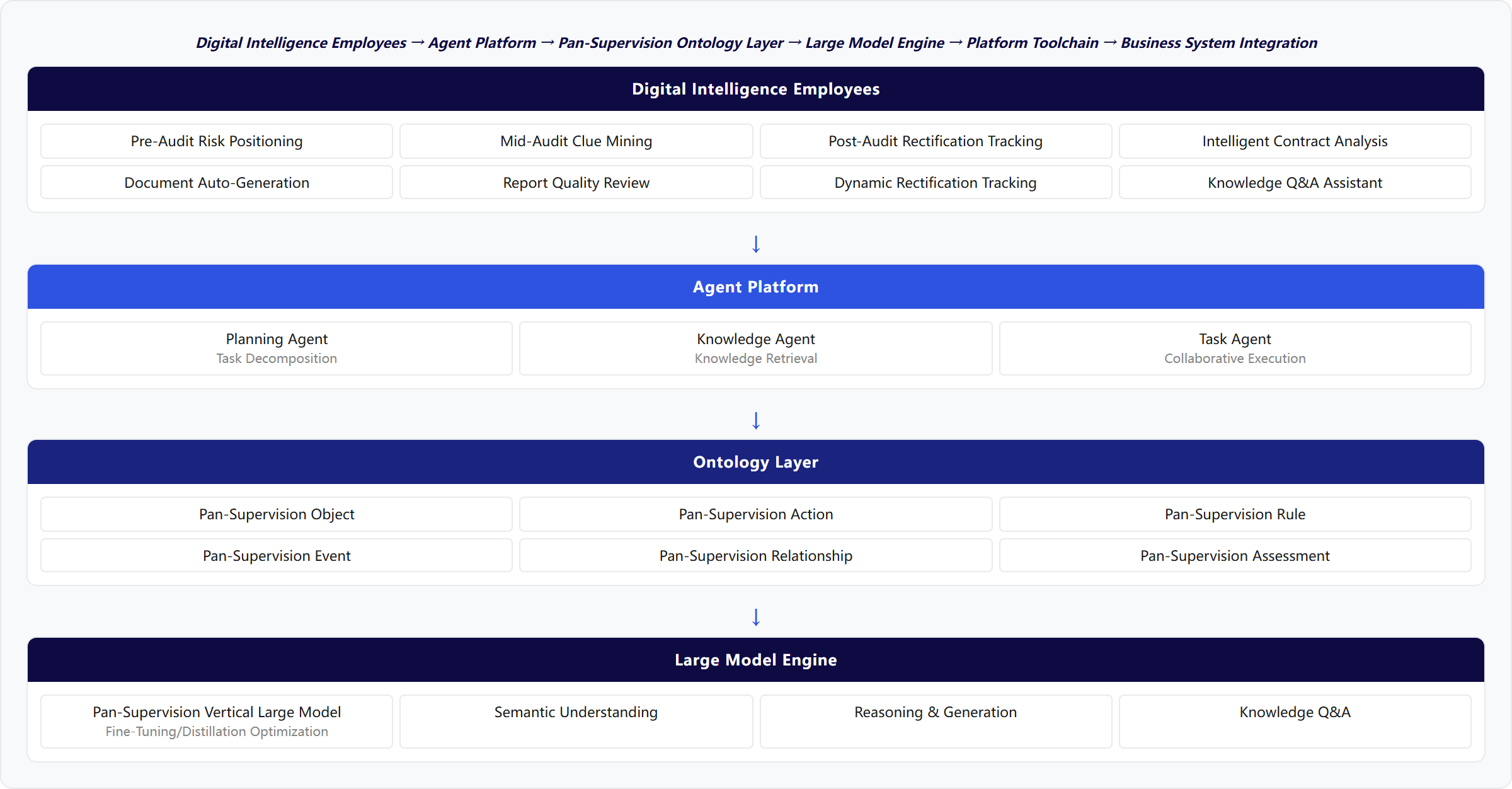
Based on Agentic architecture, through multi-agent collaboration (such as contract fund return verification agent, excessive debt warning agent, and holding-without-control identification agent), we achieve full-process unmanned operation from risk discovery to rectification tracking. Digital intelligence employees are equipped for audit, supervision, and compliance positions (such as audit plan preparation assistant, working paper preparation assistant, issue qualification assistant, and report drafting assistant). These digital employees possess professional skills, memory libraries, and deep chain-of-thought capabilities, and can independently complete full-process tasks such as institutional compliance checks, audit document generation, project progress monitoring, and quality performance evaluation.
Customer Pain Points

  • Supervision personnel have much repetitive work; working paper writing and document proofreading are time-consuming; audit document writing (reports, working papers, notices, etc.) relies on experience transfer, with uneven quality, slow onboarding for newcomers, and inconsistent standards.
  • During audits and other processes, facing massive unstructured data (contract texts, business documents, approval materials, etc.), manual extraction of key elements and comparative analysis is time-consuming and laborious, and hidden risks are easily missed.
  • Rectification tracking relies on manual ledgers and offline supervision, with long rectification cycles, difficult closed loops, and prominent repeated findings across audits; issue rectification lacks a closed loop.
  • Supervision models are disconnected from business systems, and rule update costs are high.
  • Cross-department collaboration efficiency is low, and verification tasks are often shelved.

Solution Advantages

  • 200+ professional agents: covering high-frequency supervision scenarios such as abnormal capital flows, fictitious trade, investment compliance, and safety production. Multi-agent collaborative execution and continuous evolution achieve data penetration, behavior penetration, entity penetration, and business penetration.
  • Full-process coverage: from project initiation, pre-audit preparation, on-site implementation, report preparation to rectification archiving, each step has dedicated agent assistance.
  • Unstructured data penetrating verification: through large-model understanding capabilities, key elements are extracted in batches from contract texts and business documents, achieving two-way mapping between structured and unstructured data, and successfully opening up audit applications for unstructured data.
  • Intelligent evidence chain discovery: through diverse analysis methods such as text comparison, intelligent modeling, and self-service visual analysis, various data elements are deeply mined, scattered evidence is closely associated, and evidence chains are discovered from massive materials.
  • Dynamic risk immunity and closed-loop management: after project archiving, high-frequency issue rectification lists are automatically generated, fundamentally identifying recurring audit findings, systematically investigating hidden risks, forming a closed-loop management of "risk identification → rectification implementation → system optimization," and significantly reducing the recurrence rate of similar issues.
  • Automatic dispatch and supervision: after risks are triggered, verification tasks are automatically generated, rectification progress is intelligently tracked, and overdue items are automatically escalated with early warnings.

Architecture Diagram

Architecture Diagram