AI-Driven HarmonyOS Application Development Solution

AI-enabled full-process empowerment, from source code scanning to automated code conversion, enabling efficient HarmonyOS application development

Functional Overview

From in-depth source code scanning, feasibility analysis, and API difference identification, to AI automatic code conversion (generating 60-70% of the code), intervention point annotation, task decomposition, quality detection, and test case generation.

Customer Pain Points

  • High technical threshold and long development cycle: Migrating from Android to HarmonyOS involves language (Java/Kotlin → ArkTS), framework (Android SDK → HarmonyOS SDK), distributed capability adaptation, and other technical challenges, making traditional manual code conversion time-consuming and labor-intensive.
  • Difficult API difference identification: There are significant API differences between Android and HarmonyOS systems. Developers need to compare and design alternative solutions one by one, easily leading to omissions and functional missing.
  • Code quality is difficult to guarantee: Manual code conversion easily introduces defects, lacks automated quality detection methods, and causes serious rework in later testing.
  • Insufficient project management standardization: HarmonyOS transformation projects lack mature methodologies and standardized processes, leading to uncontrollable costs and delayed delivery.

Solution Advantages

  • Full-process AI automation: In phase 1, AI completes in-depth scanning and outputs a technical analysis report (including module dependencies, API difference lists, and risk identification); in phase 2, it automatically performs refined workload estimation and intelligent task decomposition; in phase 3, it completes 60-70% automatic code conversion, automatically annotating the remaining 30% intervention points that require manual processing (priority P0/P1/P2); in phase 4, it performs static code scanning, intervention point coverage verification, quality scoring, automated regression testing, UI comparison, and performance baseline testing.
  • Standardized SOP process: Strictly follows a six-stage standardized process (business acceptance → technical diagnosis → technical solution → AI code conversion → quality detection → acceptance and launch), with gate control nodes at each stage to ensure delivery quality. The four-dimensional acceptance criteria include functional coverage ≥ 95%, performance ≤ 1.2x of the Android version, UI fidelity up to standard, and passing Huawei AppMarket review.
  • Intelligent task decomposition and talent matching: Based on task skill tags, time windows, and historical ratings, AI automatically recommends matching development engineers, supporting role-level (architect/PM) and skill-level (ArkTS/ArkUI/HMS SDK) personnel scheduling. New or external personnel undergo targeted evaluation through Gohire before onboarding.
  • Three-tier flexible change management rules: Changes with workload ≤ 2 person-days are quickly digested by AI creating sub-tasks; changes of 3-5 person-days are quickly confirmed after PM evaluation; formal changes of >5 person-days or architecture changes are re-quoted and initiated after customer written confirmation, with change logs recorded throughout the process.

Architecture Diagram
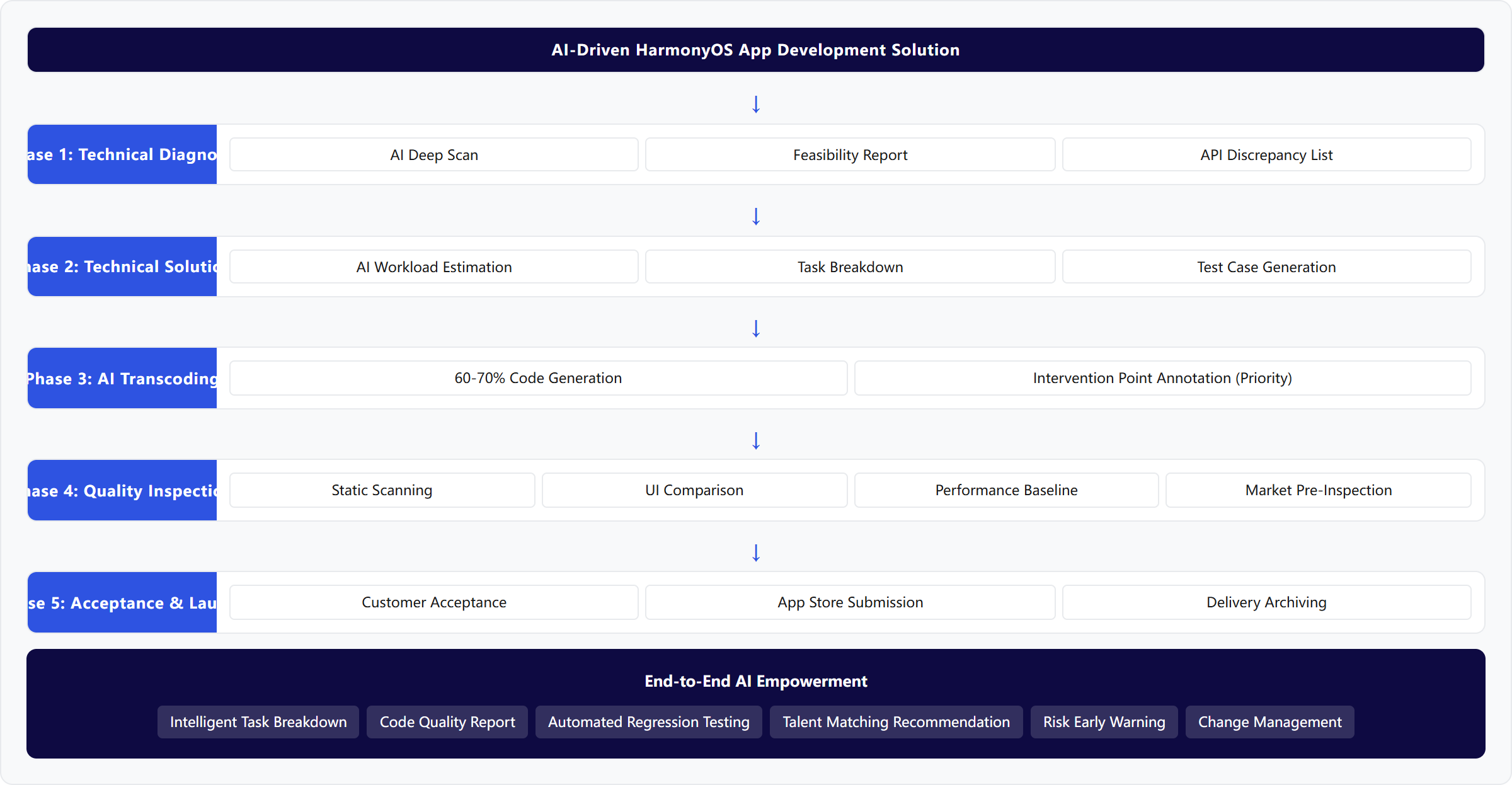
Architecture Diagram